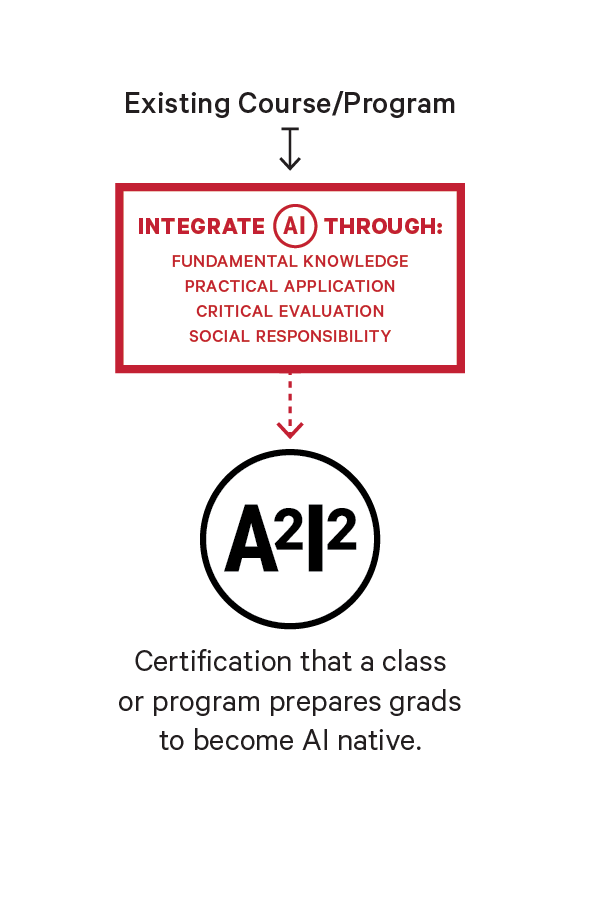
The MSOE Applied AI Integration (A2I2) Process weaves applied AI into every degree program. Rather than relying on a handful of generalized standalone “AI Literacy” courses for students of any major, MSOE’s approach embeds AI directly into existing discipline-specific curricula. This ensures students across all disciplines build practical, project-based experience in their field of study. They will graduate from MSOE with AI proficiency at the depth and rigor required for contemporary practice in their disciplines.
The A2I2 framework is built around four core ideas: foundational knowledge, practical application, critical evaluation and social responsibility. Together, these pillars aim to balance technical skill with social and ethical awareness. Programs and courses earn A2I2 certification by demonstrating meaningful integration of these elements through updated outcomes, coursework and projects.
What sets MSOE apart is its standards-based approach for degree program certification. With this process, MSOE guarantees students graduating from A2I2-certified degree programs have AI proficiency specific to their field of study.
This initiative positions MSOE at the forefront of applied learning—preparing graduates not just to use AI, but to be AI native and lead responsible adoption in a rapidly evolving technological landscape.
Explore more about A2I2 by visiting our academic catalog and browsing our programs below.
Undergraduate AI Programs
B.S. in Biomedical Engineering (AI Path)
Biomedical engineers use engineering principles to create and enhance health care equipment and technology. The AI path includes courses that prepare students for careers involving data science, machine learning and AI in the medical device industry and biomedical research.
B.S. in Computer Science
Graduates of MSOE’s computer science program will be prepared to write cutting-edge software to solve tomorrow’s problems with a special emphasis on machine learning and artificial intelligence.
B.S. in Cybersecurity Systems
The cybersecurity systems program integrates science and mathematics with computer science, software engineering, political science and ethics to prepare a computing professional capable of developing and deploying computing systems that consistently maintain confidentiality, integrity and availability.
B.S. in Software Engineering
Software engineering applies engineering concepts, techniques and methods to the development of software systems. The software engineering program develops engineering professionals with a mastery of software development theory, practice and process.
B.S. in User Experience
Students in the user experience program gain essential skills to design digital experiences, products and services for customers and end users. This program embraces immersive technologies, physical product design, generative AI and foundational front-end development.
Graduate AI Programs
M.S. in Machine Learning
Leverage your programming skills and dive into advanced concepts with the Master of Science in Machine Learning. This online program includes depth of technical content, industry applications, use of Rosie the supercomputer, small classes and industry experienced faculty.